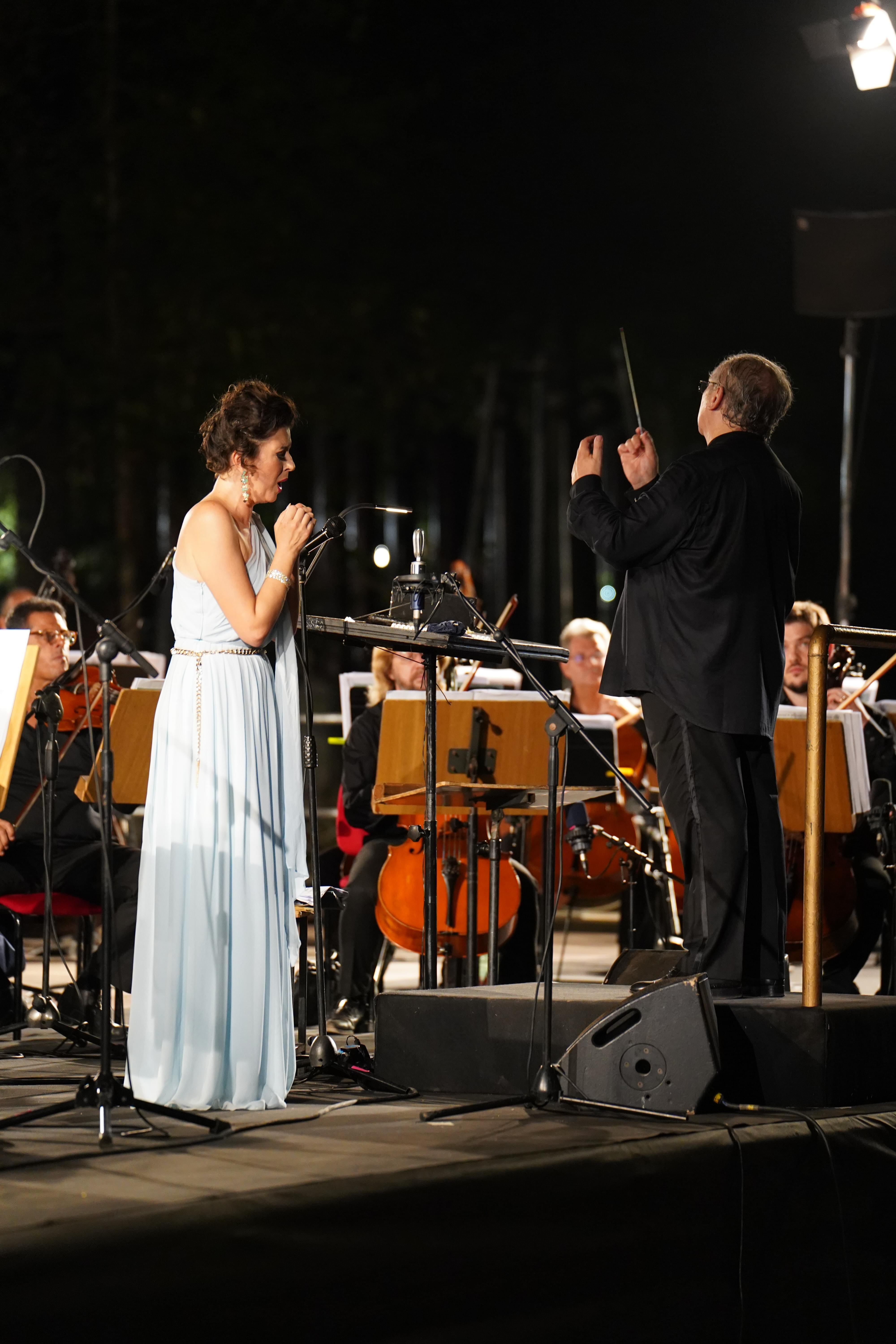
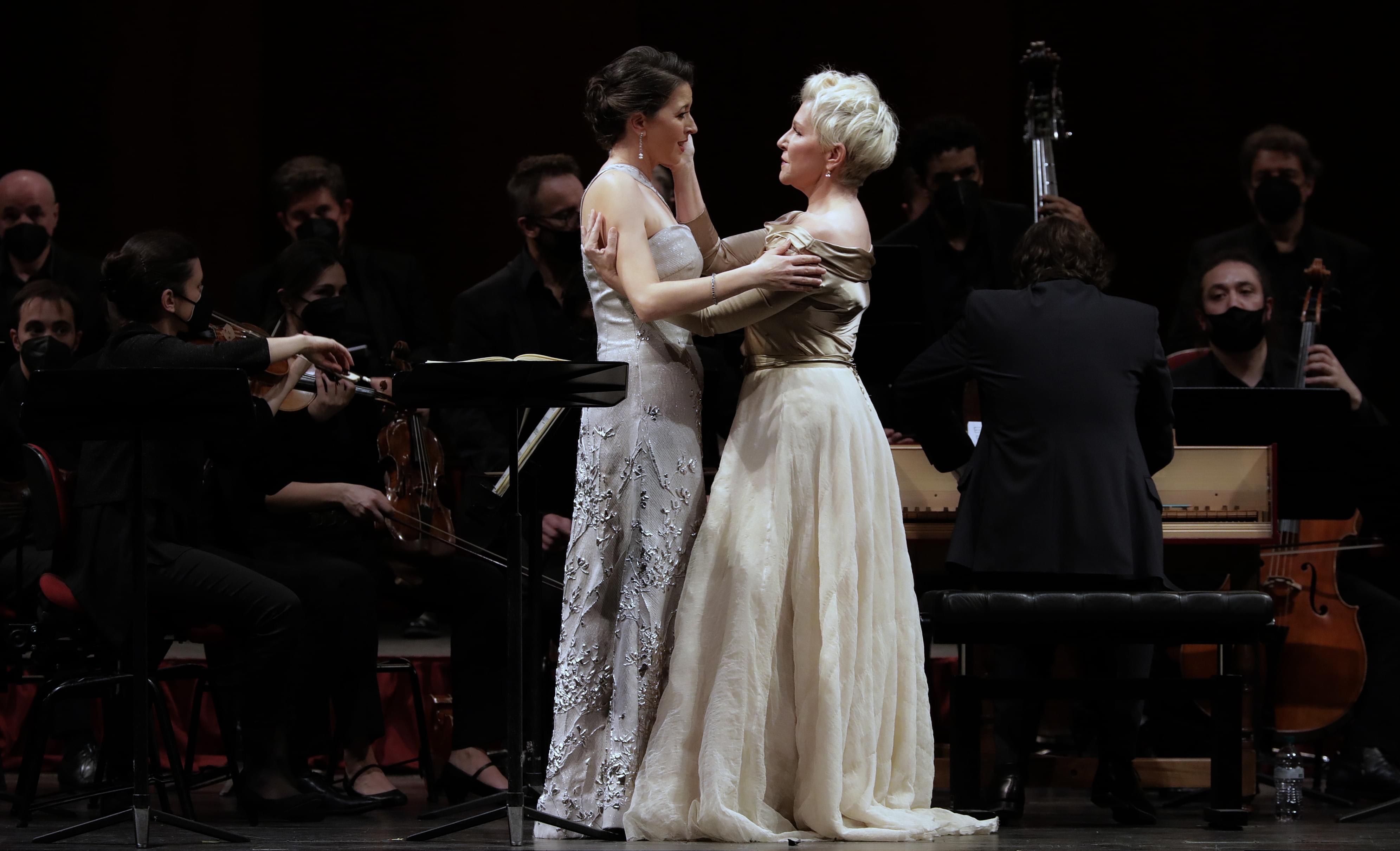
Lisette Oropesa, schwarze Locken, grau-silbriges Abendkleid, sang die Titelrolle. Sie hat mit ihrem Strahle-Sorpan als Konstanze in der Wiener Staatoper die Herzen des Publikums im Sturm erobert. Hier muss sie die „Tugendboldin“ (wie man Händels Heldin bezeichnet hat) interessant machen. Sie tut es so weit wie möglich mit Stimme, Technik und lebhaftem Minenspiel, dessen sich auch alle anderen Sänger bedienen: Wenn man das Ganze schon nicht spielen darf (das Programmheft kündigt allerdings eine szenische Aufführung mit dieser Besetzung irgendwann irgendwo an), dann muss man doch wenigstens zeigen, wie man fühlt und leidet. Leidet vor allem, denn Theodora wird verfolgt, soll zur Prostitution gezwungen werden, will das Opfer des Didymus, der sie retten möchte, nicht annehmen… kurz, selbst wenn man den englischen Text nicht mitliest, weiß man doch nach der Inhaltsangabe worum es geht. Tragisch.
Lisette Oropesa, with her black curls and grey-silver evening dress, sang the title role. She captured the hearts of the audience with her beaming Soprano as Konstanze in the Vienna State Opera. Here she must make the “Tugendboldin” (as Handel's heroine has been described) interesting. She does it as much as possible with her voice, technique, and lively facial expressions, which all the other singers also use: If you are not allowed to play the whole thing (however, the programme does announce a staged performance with this cast at some point somewhere), you must at least show how you feel and suffer. Suffer above all, because Theodora is being persecuted, is to be forced into prostitution, does not want to accept the sacrifice of Didymus, who wants to save her... in short, even if you don't read along with the English text, you still know from the synopsis what it's all about. Tragic.
—
Renate Wagner
•
Online Merker

:format(webp)/https://lisetteoropesa.com/media/gallery/2025/festspielhaus-baden-baden-concert/03-lisette-oropesa_header.jpg)
:format(webp)/https://lisetteoropesa.com/media/gallery/2021/ravello-festival-concert/08-lisette-oropesa.jpg)
:format(webp)/https://lisetteoropesa.com/media/gallery/2021/teatro-de-la-maestranza-recital/01-lisette-oropesa.jpg)
:format(webp)/https://lisetteoropesa.com/media/gallery/2021/teatro-de-la-zarzuela-recital/04-lisette-oropesa-ruben-fernandez-aguirre.jpg)



:format(webp)/https://lisetteoropesa.com/media/gallery/2021/teatro-alla-scala-theodora/04-lisette-oropesa-joyce-didonato.jpg)

:format(webp)/https://lisetteoropesa.com/media/gallery/2021/royal-opera-house-la-traviata/12-lisette-oropesa.jpg)
:format(webp)/https://lisetteoropesa.com/media/gallery/2021/teatro-regio-di-parma-recital/02-lisette-oropesa-franceso-izzo.jpg)
:format(webp)/https://lisetteoropesa.com/media/gallery/2021/nachtigall-artists-recital/05-lisette-oropesa-ruben-fernandez-aguirre.jpg)
:format(webp)/https://lisetteoropesa.com/media/gallery/2021/royal-opera-house-rigoletto/05-lisette-oropesa-liparit-avetisyan.jpg)
:format(webp)/https://lisetteoropesa.com/media/gallery/2021/bellininfest-concert/06-lisette-oropesa.jpg)



:format(webp)/https://lisetteoropesa.com/media/gallery/2021/teatro-dell-opera-di-roma-la-traviata/01-lisette-oropesa.jpg)

:format(webp)/https://lisetteoropesa.com/media/gallery/2021/ravello-festival-concert/07-lisette-oropesa.jpg)
:format(webp)/https://lisetteoropesa.com/media/gallery/2021/ravello-festival-concert/01-lisette-oropesa.jpg)
:format(webp)/https://lisetteoropesa.com/media/gallery/2021/ravello-festival-concert/02-lisette-oropesa.jpg)
:format(webp)/https://lisetteoropesa.com/media/gallery/2021/ravello-festival-concert/03-lisette-oropesa.jpg)
:format(webp)/https://lisetteoropesa.com/media/gallery/2021/ravello-festival-concert/04-lisette-oropesa.jpg)
:format(webp)/https://lisetteoropesa.com/media/gallery/2021/ravello-festival-concert/06-lisette-oropesa.jpg)
:format(webp)/https://lisetteoropesa.com/media/gallery/2021/ravello-festival-concert/05-lisette-oropesa.jpg)
:format(webp)/https://lisetteoropesa.com/media/gallery/2021/teatro-de-la-maestranza-recital/03-lisette-oropesa.jpg)
:format(webp)/https://lisetteoropesa.com/media/gallery/2021/teatro-de-la-maestranza-recital/06-lisette-oropesa.jpg)
:format(webp)/https://lisetteoropesa.com/media/gallery/2021/teatro-de-la-maestranza-recital/05-lisette-oropesa.jpg)
:format(webp)/https://lisetteoropesa.com/media/gallery/2021/teatro-de-la-maestranza-recital/04-lisette-oropesa.jpg)
:format(webp)/https://lisetteoropesa.com/media/gallery/2021/teatro-de-la-maestranza-recital/02-lisette-oropesa.jpg)

:format(webp)/https://lisetteoropesa.com/media/gallery/2021/teatro-de-la-zarzuela-recital/02-lisette-oropesa.jpg)
:format(webp)/https://lisetteoropesa.com/media/gallery/2021/teatro-de-la-zarzuela-recital/01-lisette-oropesa.jpg)
:format(webp)/https://lisetteoropesa.com/media/gallery/2021/teatro-de-la-zarzuela-recital/05-lisette-oropesa.jpg)
:format(webp)/https://lisetteoropesa.com/media/gallery/2021/teatro-de-la-zarzuela-recital/03-lisette-oropesa-ruben-fernandez-aguirre.jpg)

:format(webp)/https://lisetteoropesa.com/media/gallery/2021/teatro-alla-scala-theodora/02-lisette-oropesa-joyce-didonato.jpg)
:format(webp)/https://lisetteoropesa.com/media/gallery/2021/teatro-alla-scala-theodora/03-lisette-oropesa-joyce-didonato.jpg)
:format(webp)/https://lisetteoropesa.com/media/gallery/2021/teatro-alla-scala-theodora/01-lisette-oropesa-joyce-didonato.jpg)
:format(webp)/https://lisetteoropesa.com/media/gallery/2021/royal-opera-house-la-traviata/06-lisette-oropesa.jpg)
:format(webp)/https://lisetteoropesa.com/media/gallery/2021/royal-opera-house-la-traviata/09-lisette-oropesa-renata-skarelyte.jpg)
:format(webp)/https://lisetteoropesa.com/media/gallery/2021/royal-opera-house-la-traviata/10-lisette-oropesa-renata-skarelyte-blaise-malaba.jpg)
:format(webp)/https://lisetteoropesa.com/media/gallery/2021/royal-opera-house-la-traviata/11-lisette-oropesa.jpg)
:format(webp)/https://lisetteoropesa.com/media/gallery/2021/royal-opera-house-la-traviata/13-lisette-oropesa.jpg)
:format(webp)/https://lisetteoropesa.com/media/gallery/2021/royal-opera-house-la-traviata/05-lisette-oropesa-liparit-avetisyan.jpg)
:format(webp)/https://lisetteoropesa.com/media/gallery/2021/royal-opera-house-la-traviata/01-lisette-oropesa.jpg)
:format(webp)/https://lisetteoropesa.com/media/gallery/2021/royal-opera-house-la-traviata/02-lisette-oropesa.jpg)
:format(webp)/https://lisetteoropesa.com/media/gallery/2021/royal-opera-house-la-traviata/03-lisette-oropesa.jpg)
:format(webp)/https://lisetteoropesa.com/media/gallery/2021/royal-opera-house-la-traviata/14-lisette-oropesa.jpg)
:format(webp)/https://lisetteoropesa.com/media/gallery/2021/royal-opera-house-la-traviata/15-lisette-oropesa-liparit-avetisyan.jpg)
:format(webp)/https://lisetteoropesa.com/media/gallery/2021/royal-opera-house-la-traviata/16-lisette-oropesa-liparit-avetisyan-renata-skarelyte.jpg)
:format(webp)/https://lisetteoropesa.com/media/gallery/2021/royal-opera-house-la-traviata/17-lisette-oropesa-christian-gerhaher.jpg)
:format(webp)/https://lisetteoropesa.com/media/gallery/2021/royal-opera-house-la-traviata/04-lisette-oropesa.jpg)
:format(webp)/https://lisetteoropesa.com/media/gallery/2021/royal-opera-house-la-traviata/08-lisette-oropesa-stephanie-wake-edwards-blaise-malaba.jpg)
:format(webp)/https://lisetteoropesa.com/media/gallery/2021/royal-opera-house-la-traviata/07-lisette-oropesa-stephanie-wake-edwards-yuriy-yurchuk.jpg)
:format(webp)/https://lisetteoropesa.com/media/gallery/2021/teatro-regio-di-parma-recital/04-lisette-oropesa-franceso-izzo.jpg)
:format(webp)/https://lisetteoropesa.com/media/gallery/2021/teatro-regio-di-parma-recital/06-lisette-oropesa-franceso-izzo.jpg)
:format(webp)/https://lisetteoropesa.com/media/gallery/2021/teatro-regio-di-parma-recital/07-lisette-oropesa-franceso-izzo.jpg)
:format(webp)/https://lisetteoropesa.com/media/gallery/2021/teatro-regio-di-parma-recital/08-lisette-oropesa.jpg)
:format(webp)/https://lisetteoropesa.com/media/gallery/2021/teatro-regio-di-parma-recital/05-lisette-oropesa.jpg)
:format(webp)/https://lisetteoropesa.com/media/gallery/2021/teatro-regio-di-parma-recital/09-lisette-oropesa-franceso-izzo.jpg)
:format(webp)/https://lisetteoropesa.com/media/gallery/2021/teatro-regio-di-parma-recital/10-lisette-oropesa.jpg)
:format(webp)/https://lisetteoropesa.com/media/gallery/2021/teatro-regio-di-parma-recital/01-lisette-oropesa-franceso-izzo.jpg)
:format(webp)/https://lisetteoropesa.com/media/gallery/2021/teatro-regio-di-parma-recital/03-lisette-oropesa.jpg)
:format(webp)/https://lisetteoropesa.com/media/gallery/2021/nachtigall-artists-recital/01-lisette-oropesa-ruben-fernandez-aguirre.jpg)
:format(webp)/https://lisetteoropesa.com/media/gallery/2021/nachtigall-artists-recital/07-lisette-oropesa-ruben-fernandez-aguirre.jpg)
:format(webp)/https://lisetteoropesa.com/media/gallery/2021/nachtigall-artists-recital/02-lisette-oropesa-ruben-fernandez-aguirre.jpg)
:format(webp)/https://lisetteoropesa.com/media/gallery/2021/nachtigall-artists-recital/03-lisette-oropesa.jpg)
:format(webp)/https://lisetteoropesa.com/media/gallery/2021/nachtigall-artists-recital/04-lisette-oropesa-ruben-fernandez-aguirre.jpg)
:format(webp)/https://lisetteoropesa.com/media/gallery/2021/nachtigall-artists-recital/06-lisette-oropesa.jpg)
:format(webp)/https://lisetteoropesa.com/media/gallery/2021/royal-opera-house-rigoletto/06-lisette-oropesa.jpg)
:format(webp)/https://lisetteoropesa.com/media/gallery/2021/royal-opera-house-rigoletto/01-lisette-oropesa-carlos-alvarez.jpg)
:format(webp)/https://lisetteoropesa.com/media/gallery/2021/royal-opera-house-rigoletto/02-lisette-oropesa-carlos-alvarez.jpg)
:format(webp)/https://lisetteoropesa.com/media/gallery/2021/royal-opera-house-rigoletto/03-lisette-oropesa-carlos-alvarez.jpg)
:format(webp)/https://lisetteoropesa.com/media/gallery/2021/royal-opera-house-rigoletto/04-lisette-oropesa-carlos-alvarez.jpg)
:format(webp)/https://lisetteoropesa.com/media/gallery/2021/royal-opera-house-rigoletto/07-lisette-oropesa.jpg)
:format(webp)/https://lisetteoropesa.com/media/gallery/2021/bellininfest-concert/02-lisette-oropesa.jpg)
:format(webp)/https://lisetteoropesa.com/media/gallery/2021/bellininfest-concert/03-lisette-oropesa.jpg)
:format(webp)/https://lisetteoropesa.com/media/gallery/2021/bellininfest-concert/01-lisette-oropesa.jpg)
:format(webp)/https://lisetteoropesa.com/media/gallery/2021/bellininfest-concert/04-lisette-oropesa.jpg)
:format(webp)/https://lisetteoropesa.com/media/gallery/2021/bellininfest-concert/05-lisette-oropesa.jpg)