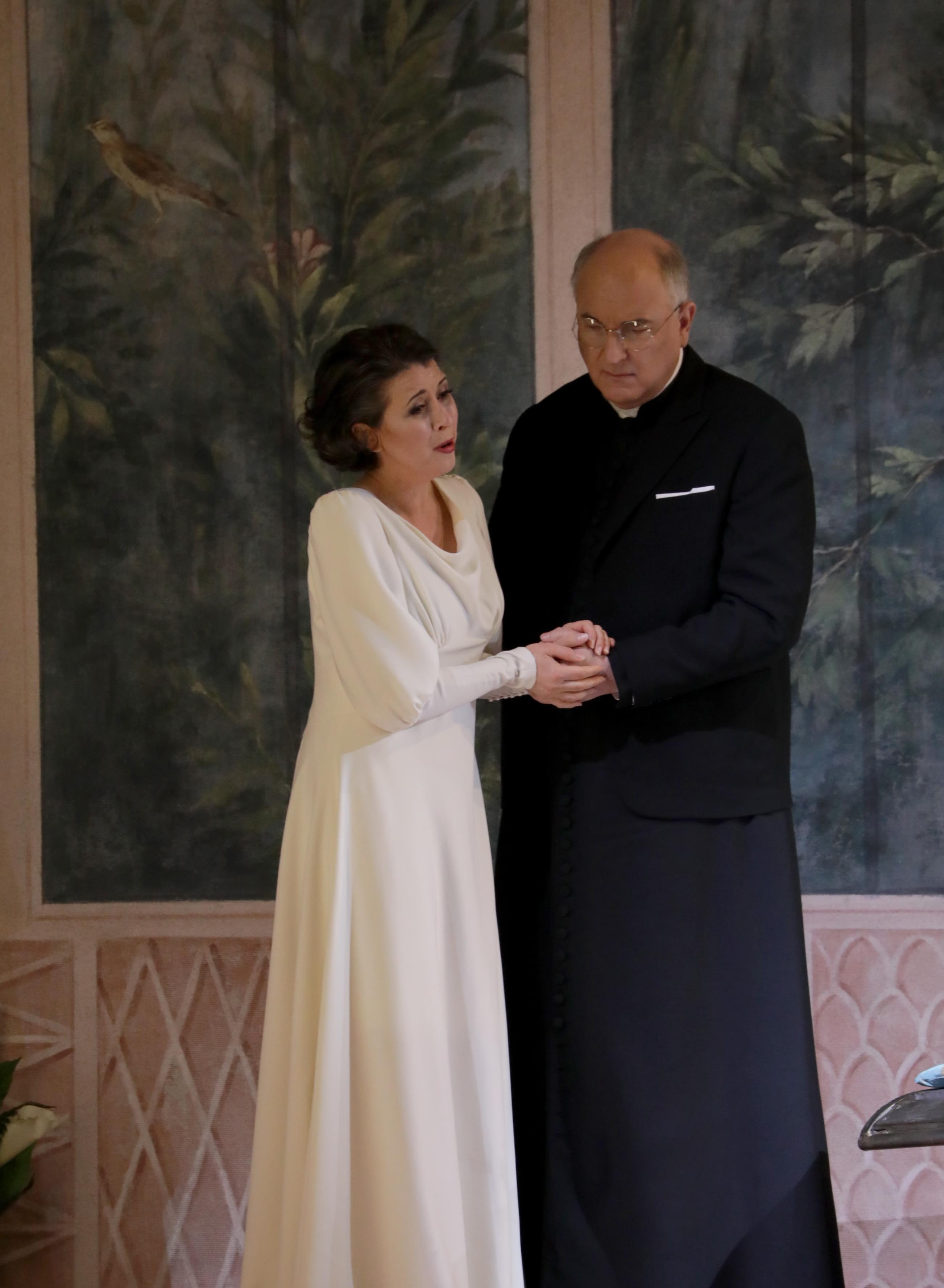
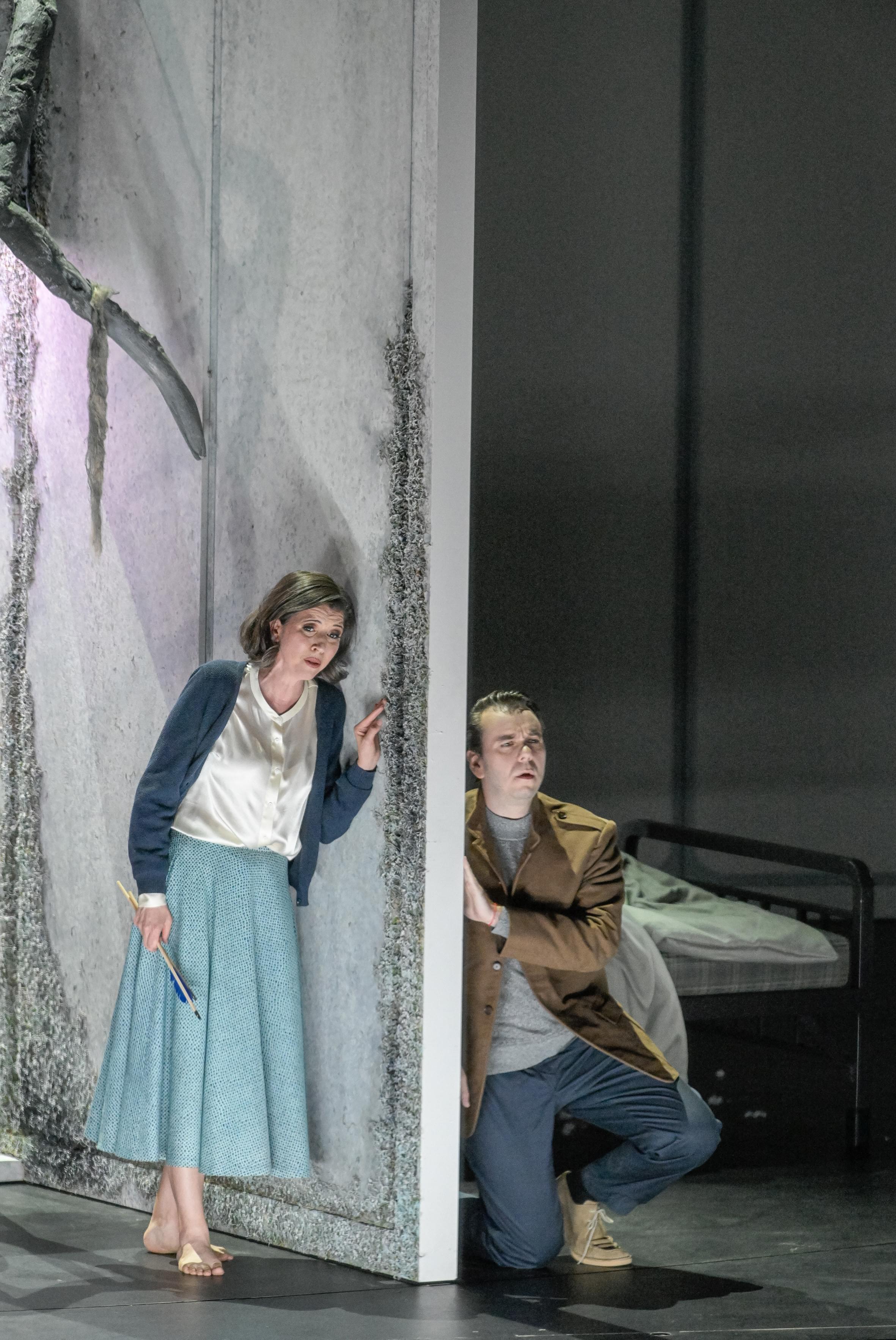
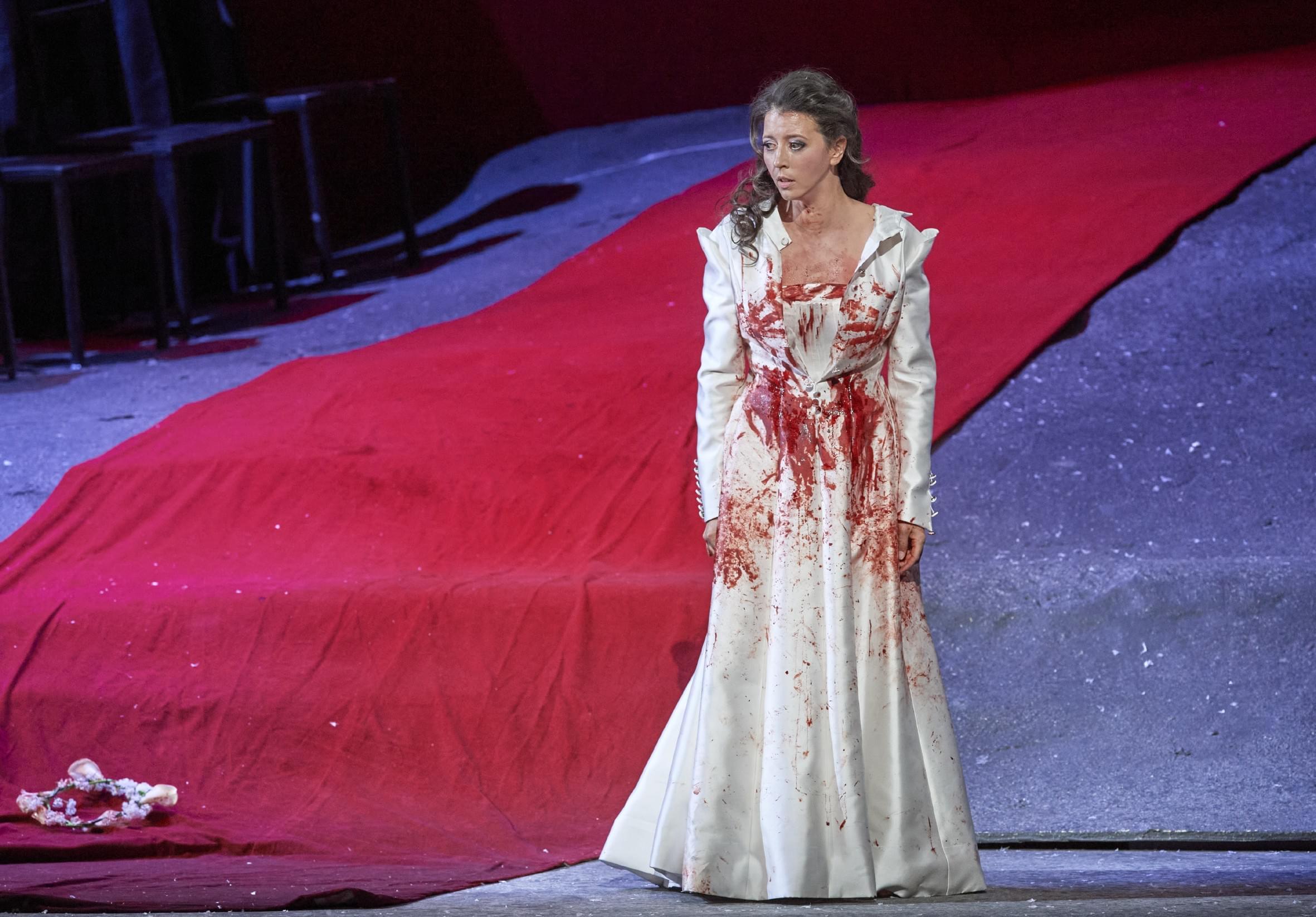
Lisette Oropesa enfin. Le public viennois, ou ce qui en restait après quinze minutes (chronométrées !) d’applaudissements puis de standing ovations au bord de la fosse, l'a réclamée à cor et à cri pour lui dire toute sa gratitude à l’issue de ces quatre représentations. On le sait, elle est aujourd’hui l’une des plus belles titulaires de ce rôle. Si elle semble aussi crédible dans l’incarnation de Lucia, c’est qu’elle y est à la fois si forte et si fragile. Une belle idée de la mise en scène consiste à nous montrer dès le début du I sa fragilité, en figurant une jeune femme, presque adolescente, insouciante et sautillant dans la neige en s’ébrouant, jouant des flocons qui tombent et n’écoutant pas ce qu’Alisa lui rapporte. Entre cette ingénue inconsciente et la jeune mariée criminelle, ravagée par la folie, en fin de parcours, quel contraste ! Oropesa joue de sa voix comme la fillette des flocons. Elle est capable de la hisser jusqu’aux plus hautes sphères de la gamme, et d’y rester, de jouer avec les notes, de les rallonger et de se complaire en haute altitude. Le fil est léger, mais il tient. A cet égard, la faire marcher, pendant la scène de la folie, sur une rangée de chaises inexplicablement alignées devant le chœur, visualise parfaitement cette œuvre de funambule, en équilibre constant et toujours périlleux.
Finally, Lisette Oropesa. The Vienna audience, or what remained of it after fifteen minutes (timed!) of applause and standing ovations at the edge of the pit, had clamored for her to express their gratitude at the end of these four performances. As we know, she's currently one of the finest performers in this role. If she seems so credible in embodying Lucia, it's because she's both so strong yet so fragile. A beautiful idea from the staging was showing her vulnerability right from the beginning of Act I, depicting a young, almost adolescent woman, carefree and hopping in the snow, shaking off, playing with the falling flakes and not listening to what Alisa is reporting. What a contrast between this innocent naive girl and the young bride turned criminal, ravaged by madness, at the end of her journey! Oropesa plays her voice like the little girl plays with the snowflakes. She's able to lift it to the highest spheres of the range, and stay there, play with the notes, elongate them and revel in high altitude. The string is light, but it holds. In this regard, making her walk, during the madness scene, on a row of mysteriously aligned chairs in front of the choir, perfectly visualizes this tightrope act, perpetually precarious and always balancing.
—
Thierry Verger
•
Forum Opéra

:format(webp)/https://lisetteoropesa.com/media/gallery/2020/teatro-alla-scala-a-riveder-le-stelle/06-lisette-oropesa_header.jpg)
:format(webp)/https://lisetteoropesa.com/media/gallery/2022/metropolitan-opera-rigoletto/01-lisette-oropesa.jpg)
:format(webp)/https://lisetteoropesa.com/media/gallery/2022/royal-opera-house-alcina/16-lisette-oropesa-rupert-charlesworth.jpg)
:format(webp)/https://lisetteoropesa.com/media/gallery/2022/teatro-san-carlo-i-puritani/06-lisette-oropesa-xavier-anduaga.jpg)
:format(webp)/https://lisetteoropesa.com/media/gallery/2022/salzburger-festspiele-lucia-di-lammermoor/01-lisette-oropesa-daniele-rustioni.jpg)
:format(webp)/https://lisetteoropesa.com/media/gallery/2022/arena-di-verona-la-traviata/09-lisette-oropesa.jpg)
:format(webp)/https://lisetteoropesa.com/media/gallery/2022/bayerische-staatsoper-la-traviata/03-lisette-oropesa.jpg)
:format(webp)/https://lisetteoropesa.com/media/gallery/2022/opernhaus-zurich-lucia-di-lammermoor/05-lisette-oropesa-benjamin-berenheim.jpg)
:format(webp)/https://lisetteoropesa.com/media/gallery/2022/wiener-staatsoper-lucia-di-lammermoor/15-lisette-oropesa.jpg)
:format(webp)/https://lisetteoropesa.com/media/gallery/2022/wiener-staatsoper-rigoletto/04-lisette-oropesa.jpg)
:format(webp)/https://lisetteoropesa.com/media/gallery/2022/wiener-staatsoper-die-entfuhrung-aus-dem-serail/02-lisette-oropesa.jpg)
:format(webp)/https://lisetteoropesa.com/media/gallery/2022/teatro-alla-scala-i-capuleti-e-i-montecchi/03-lisette-oropesa-michele-pertusi.jpg)
:format(webp)/https://lisetteoropesa.com/media/gallery/2022/metropolitan-opera-rigoletto/02-lisette-oropesa-luca-salsi.jpg)

:format(webp)/https://lisetteoropesa.com/media/gallery/2022/royal-opera-house-alcina/14-lisette-oropesa-emily-dangelo.jpg)
:format(webp)/https://lisetteoropesa.com/media/gallery/2022/royal-opera-house-alcina/15-lisette-oropesa-mary-bevan.jpg)
:format(webp)/https://lisetteoropesa.com/media/gallery/2022/royal-opera-house-alcina/06-lisette-oropesa.jpg)
:format(webp)/https://lisetteoropesa.com/media/gallery/2022/royal-opera-house-alcina/07-lisette-oropesa.jpg)
:format(webp)/https://lisetteoropesa.com/media/gallery/2022/royal-opera-house-alcina/08-lisette-oropesa.jpg)
:format(webp)/https://lisetteoropesa.com/media/gallery/2022/royal-opera-house-alcina/10-lisette-oropesa.jpg)
:format(webp)/https://lisetteoropesa.com/media/gallery/2022/royal-opera-house-alcina/09-lisette-oropesa-malachai-bayaoh.jpg)
:format(webp)/https://lisetteoropesa.com/media/gallery/2022/royal-opera-house-alcina/13-lisette-oropesa.jpg)
:format(webp)/https://lisetteoropesa.com/media/gallery/2022/royal-opera-house-alcina/11-lisette-oropesa-mary-bevan-ruper-charlesworth.jpg)
:format(webp)/https://lisetteoropesa.com/media/gallery/2022/royal-opera-house-alcina/12-lisette-oropesa-emily-dangelo.jpg)
:format(webp)/https://lisetteoropesa.com/media/gallery/2022/royal-opera-house-alcina/02-lisette-oropesa.jpg)
:format(webp)/https://lisetteoropesa.com/media/gallery/2022/royal-opera-house-alcina/01-lisette-oropesa.jpg)
:format(webp)/https://lisetteoropesa.com/media/gallery/2022/royal-opera-house-alcina/03-lisette-oropesa.jpg)
:format(webp)/https://lisetteoropesa.com/media/gallery/2022/royal-opera-house-alcina/04-lisette-oropesa.jpg)
:format(webp)/https://lisetteoropesa.com/media/gallery/2022/royal-opera-house-alcina/05-lisette-oropesa.jpg)
:format(webp)/https://lisetteoropesa.com/media/gallery/2022/teatro-san-carlo-i-puritani/03-lisette-oropesa.jpg)
:format(webp)/https://lisetteoropesa.com/media/gallery/2022/teatro-san-carlo-i-puritani/01-lisette-oropesa.jpg)
:format(webp)/https://lisetteoropesa.com/media/gallery/2022/teatro-san-carlo-i-puritani/05-lisette-oropesa-xavier-anduaga.jpg)
:format(webp)/https://lisetteoropesa.com/media/gallery/2022/teatro-san-carlo-i-puritani/08-lisette-oropesa.jpg)
:format(webp)/https://lisetteoropesa.com/media/gallery/2022/teatro-san-carlo-i-puritani/09-lisette-oropesa.jpg)
:format(webp)/https://lisetteoropesa.com/media/gallery/2022/teatro-san-carlo-i-puritani/02-lisette-oropesa.jpg)
:format(webp)/https://lisetteoropesa.com/media/gallery/2022/teatro-san-carlo-i-puritani/10-lisette-oropesa.jpg)
:format(webp)/https://lisetteoropesa.com/media/gallery/2022/teatro-san-carlo-i-puritani/07-lisette-oropesa-xavier-anduaga.jpg)
:format(webp)/https://lisetteoropesa.com/media/gallery/2022/teatro-san-carlo-i-puritani/04-lisette-oropesa.jpg)

:format(webp)/https://lisetteoropesa.com/media/gallery/2022/salzburger-festspiele-lucia-di-lammermoor/03-lisette-oropesa.jpg)
:format(webp)/https://lisetteoropesa.com/media/gallery/2022/salzburger-festspiele-lucia-di-lammermoor/02-lisette-oropesa-daniele-rustioni.jpg)
:format(webp)/https://lisetteoropesa.com/media/gallery/2022/salzburger-festspiele-lucia-di-lammermoor/05-lisette-oropesa-daniele-rustioni.jpg)
:format(webp)/https://lisetteoropesa.com/media/gallery/2022/salzburger-festspiele-lucia-di-lammermoor/04-lisette-oropesa-ludovic-tezier-benjamin-berenheim-daniele-rustioni-robert-tagliavini.jpg)
:format(webp)/https://lisetteoropesa.com/media/gallery/2022/arena-di-verona-la-traviata/07-lisette-oropesa.jpg)
:format(webp)/https://lisetteoropesa.com/media/gallery/2022/arena-di-verona-la-traviata/06-lisette-oropesa.jpg)
:format(webp)/https://lisetteoropesa.com/media/gallery/2022/arena-di-verona-la-traviata/05-lisette-oropesa.jpg)
:format(webp)/https://lisetteoropesa.com/media/gallery/2022/arena-di-verona-la-traviata/04-lisette-oropesa.jpg)
:format(webp)/https://lisetteoropesa.com/media/gallery/2022/arena-di-verona-la-traviata/03-lisette-oropesa.jpg)
:format(webp)/https://lisetteoropesa.com/media/gallery/2022/arena-di-verona-la-traviata/01-lisette-oropesa.jpg)
:format(webp)/https://lisetteoropesa.com/media/gallery/2022/arena-di-verona-la-traviata/12-lisette-oropesa.jpg)
:format(webp)/https://lisetteoropesa.com/media/gallery/2022/arena-di-verona-la-traviata/11-lisette-oropesa.jpg)
:format(webp)/https://lisetteoropesa.com/media/gallery/2022/arena-di-verona-la-traviata/10-lisette-oropesa.jpg)
:format(webp)/https://lisetteoropesa.com/media/gallery/2022/arena-di-verona-la-traviata/02-lisette-oropesa.jpg)
:format(webp)/https://lisetteoropesa.com/media/gallery/2022/arena-di-verona-la-traviata/08-lisette-oropesa.jpg)

:format(webp)/https://lisetteoropesa.com/media/gallery/2022/bayerische-staatsoper-la-traviata/01-lisette-oropesa-dmytro-popov.jpg)
:format(webp)/https://lisetteoropesa.com/media/gallery/2022/bayerische-staatsoper-la-traviata/07-lisette-oropesa-simon-keenlyside.jpg)
:format(webp)/https://lisetteoropesa.com/media/gallery/2022/bayerische-staatsoper-la-traviata/06-lisette-oropesa.jpg)
:format(webp)/https://lisetteoropesa.com/media/gallery/2022/bayerische-staatsoper-la-traviata/05-lisette-oropesa.jpg)
:format(webp)/https://lisetteoropesa.com/media/gallery/2022/bayerische-staatsoper-la-traviata/04-lisette-oropesa.jpg)
:format(webp)/https://lisetteoropesa.com/media/gallery/2022/bayerische-staatsoper-la-traviata/02-lisette-oropesa.jpg)
:format(webp)/https://lisetteoropesa.com/media/gallery/2022/opernhaus-zurich-lucia-di-lammermoor/16-lisette-oropesa.jpg)
:format(webp)/https://lisetteoropesa.com/media/gallery/2022/opernhaus-zurich-lucia-di-lammermoor/15-lisette-oropesa.jpg)
:format(webp)/https://lisetteoropesa.com/media/gallery/2022/opernhaus-zurich-lucia-di-lammermoor/01-lisette-oropesa-massimo-cavalletti.jpg)
:format(webp)/https://lisetteoropesa.com/media/gallery/2022/opernhaus-zurich-lucia-di-lammermoor/02-lisette-oropesa.jpg)
:format(webp)/https://lisetteoropesa.com/media/gallery/2022/opernhaus-zurich-lucia-di-lammermoor/03-lisette-oropesa-roswitha-christina-muller.jpg)
:format(webp)/https://lisetteoropesa.com/media/gallery/2022/opernhaus-zurich-lucia-di-lammermoor/04-lisette-oropesa-benjamin-berenheim.jpg)
:format(webp)/https://lisetteoropesa.com/media/gallery/2022/opernhaus-zurich-lucia-di-lammermoor/06-lisette-oropesa-benjamin-berenheim.jpg)
:format(webp)/https://lisetteoropesa.com/media/gallery/2022/opernhaus-zurich-lucia-di-lammermoor/07-lisette-oropesa-benjamin-berenheim.jpg)
:format(webp)/https://lisetteoropesa.com/media/gallery/2022/opernhaus-zurich-lucia-di-lammermoor/08-lisette-oropesa-benjamin-berenheim.jpg)
:format(webp)/https://lisetteoropesa.com/media/gallery/2022/opernhaus-zurich-lucia-di-lammermoor/09-lisette-oropesa-massimo-cavalletti.jpg)
:format(webp)/https://lisetteoropesa.com/media/gallery/2022/opernhaus-zurich-lucia-di-lammermoor/11-lisette-oropesa-massimo-cavaletti.jpg)
:format(webp)/https://lisetteoropesa.com/media/gallery/2022/opernhaus-zurich-lucia-di-lammermoor/10-lisette-oropesa-massimo-cavalletti.jpg)
:format(webp)/https://lisetteoropesa.com/media/gallery/2022/opernhaus-zurich-lucia-di-lammermoor/19-lisette-oropesa.jpg)
:format(webp)/https://lisetteoropesa.com/media/gallery/2022/opernhaus-zurich-lucia-di-lammermoor/18-lisette-oropesa-massimo-cavalletti.jpg)
:format(webp)/https://lisetteoropesa.com/media/gallery/2022/opernhaus-zurich-lucia-di-lammermoor/17-lisette-oropesa.jpg)
:format(webp)/https://lisetteoropesa.com/media/gallery/2022/opernhaus-zurich-lucia-di-lammermoor/14-lisette-oropesa.jpg)
:format(webp)/https://lisetteoropesa.com/media/gallery/2022/opernhaus-zurich-lucia-di-lammermoor/13-lisette-oropesa-massimo-cavaletti.jpg)
:format(webp)/https://lisetteoropesa.com/media/gallery/2022/opernhaus-zurich-lucia-di-lammermoor/12-lisette-oropesa-benjamin-berenheim.jpg)
:format(webp)/https://lisetteoropesa.com/media/gallery/2022/wiener-staatsoper-lucia-di-lammermoor/12-lisette-oropesa.jpg)
:format(webp)/https://lisetteoropesa.com/media/gallery/2022/wiener-staatsoper-lucia-di-lammermoor/11-lisette-oropesa-patricia-nolz.jpg)
:format(webp)/https://lisetteoropesa.com/media/gallery/2022/wiener-staatsoper-lucia-di-lammermoor/10-lisette-oropesa-josh-lovell.jpg)
:format(webp)/https://lisetteoropesa.com/media/gallery/2022/wiener-staatsoper-lucia-di-lammermoor/09-lisette-oropesa-roberto-tagliavini.jpg)
:format(webp)/https://lisetteoropesa.com/media/gallery/2022/wiener-staatsoper-lucia-di-lammermoor/08-lisette-oropesa-benjamin-bereheim.jpg)
:format(webp)/https://lisetteoropesa.com/media/gallery/2022/wiener-staatsoper-lucia-di-lammermoor/07-lisette-oropesa.jpg)
:format(webp)/https://lisetteoropesa.com/media/gallery/2022/wiener-staatsoper-lucia-di-lammermoor/02-lisette-oropesa-benjamin-bereheim.jpg)
:format(webp)/https://lisetteoropesa.com/media/gallery/2022/wiener-staatsoper-lucia-di-lammermoor/01-lisette-oropesa.jpg)
:format(webp)/https://lisetteoropesa.com/media/gallery/2022/wiener-staatsoper-lucia-di-lammermoor/16-lisette-oropesa.jpg)
:format(webp)/https://lisetteoropesa.com/media/gallery/2022/wiener-staatsoper-lucia-di-lammermoor/03-lisette-oropesa-george-petan.jpg)
:format(webp)/https://lisetteoropesa.com/media/gallery/2022/wiener-staatsoper-lucia-di-lammermoor/06-lisette-oropesa-roberto-tagliavini.jpg)
:format(webp)/https://lisetteoropesa.com/media/gallery/2022/wiener-staatsoper-lucia-di-lammermoor/04-lisette-oropesa-josh-lovell.jpg)
:format(webp)/https://lisetteoropesa.com/media/gallery/2022/wiener-staatsoper-lucia-di-lammermoor/05-lisette-oropesa.jpg)
:format(webp)/https://lisetteoropesa.com/media/gallery/2022/wiener-staatsoper-lucia-di-lammermoor/14-lisette-oropesa.jpg)
:format(webp)/https://lisetteoropesa.com/media/gallery/2022/wiener-staatsoper-lucia-di-lammermoor/13-lisette-oropesa.jpg)
:format(webp)/https://lisetteoropesa.com/media/gallery/2022/wiener-staatsoper-rigoletto/10-lisette-oropesa-ludovic-tezier.jpg)
:format(webp)/https://lisetteoropesa.com/media/gallery/2022/wiener-staatsoper-rigoletto/05-lisette-oropesa-ludovic-tezier.jpg)
:format(webp)/https://lisetteoropesa.com/media/gallery/2022/wiener-staatsoper-rigoletto/03-lisette-oropesa.jpg)
:format(webp)/https://lisetteoropesa.com/media/gallery/2022/wiener-staatsoper-rigoletto/01-lisette-oropesa.jpg)
:format(webp)/https://lisetteoropesa.com/media/gallery/2022/wiener-staatsoper-rigoletto/02-lisette-oropesa-francesco-demuro.jpg)
:format(webp)/https://lisetteoropesa.com/media/gallery/2022/wiener-staatsoper-rigoletto/09-lisette-oropesa-ludovic-tezier.jpg)
:format(webp)/https://lisetteoropesa.com/media/gallery/2022/wiener-staatsoper-rigoletto/08-lisette-oropesa-ludovic-tezier.jpg)
:format(webp)/https://lisetteoropesa.com/media/gallery/2022/wiener-staatsoper-rigoletto/07-lisette-oropesa-ludovic-tezier.jpg)
:format(webp)/https://lisetteoropesa.com/media/gallery/2022/wiener-staatsoper-rigoletto/06-lisette-oropesa.jpg)

:format(webp)/https://lisetteoropesa.com/media/gallery/2022/wiener-staatsoper-die-entfuhrung-aus-dem-serail/05-lisette-oropesa-tobias-kehrer-regula-muhlemann.jpg)
:format(webp)/https://lisetteoropesa.com/media/gallery/2022/wiener-staatsoper-die-entfuhrung-aus-dem-serail/06-lisette-oropesa-christian-nickel-emanuela-von-frankenberg.jpg)
:format(webp)/https://lisetteoropesa.com/media/gallery/2022/wiener-staatsoper-die-entfuhrung-aus-dem-serail/03-lisette-oropesa.jpg)
:format(webp)/https://lisetteoropesa.com/media/gallery/2022/wiener-staatsoper-die-entfuhrung-aus-dem-serail/04-lisette-oropesa-christian-nickel.jpg)
:format(webp)/https://lisetteoropesa.com/media/gallery/2022/wiener-staatsoper-die-entfuhrung-aus-dem-serail/01-lisette-oropesa-emanuela-von-frankenberg.jpg)
:format(webp)/https://lisetteoropesa.com/media/gallery/2022/teatro-alla-scala-i-capuleti-e-i-montecchi/04-lisette-oropesa-marianne-crebassa.jpg)
:format(webp)/https://lisetteoropesa.com/media/gallery/2022/teatro-alla-scala-i-capuleti-e-i-montecchi/05-lisette-oropesa-marianne-crebassa.jpg)
:format(webp)/https://lisetteoropesa.com/media/gallery/2022/teatro-alla-scala-i-capuleti-e-i-montecchi/02-lisette-oropesa.jpg)
:format(webp)/https://lisetteoropesa.com/media/gallery/2022/teatro-alla-scala-i-capuleti-e-i-montecchi/10-lisette-oropesa-marianne-crebassa.jpg)
:format(webp)/https://lisetteoropesa.com/media/gallery/2022/teatro-alla-scala-i-capuleti-e-i-montecchi/09-lisette-oropesa-johnming-park.jpg)
:format(webp)/https://lisetteoropesa.com/media/gallery/2022/teatro-alla-scala-i-capuleti-e-i-montecchi/08-lisette-oropesa.jpg)
:format(webp)/https://lisetteoropesa.com/media/gallery/2022/teatro-alla-scala-i-capuleti-e-i-montecchi/06-lisette-oropesa-marianne-crebassa.jpg)
:format(webp)/https://lisetteoropesa.com/media/gallery/2022/teatro-alla-scala-i-capuleti-e-i-montecchi/07-lisette-oropesa.jpg)
:format(webp)/https://lisetteoropesa.com/media/gallery/2022/teatro-alla-scala-i-capuleti-e-i-montecchi/01-lisette-oropesa.jpg)